

Fixing the UISplitViewController Template
The default implementation of the UISplitViewController based template in Xcode does not provide a navigation controller stack in the detail view. Instead it is just a regular old view with a navigation bar at the top. I suppose there are cases when you might want such an implementation, however, i think you would more commonly want there to be a navigation stack for cases when you wan to push new view controllers for your users to see. In this post i intend to demonstrate how to convert the default template to something more useable.
(more…)

My current Prefix.pch file
I have posted and discussed this file a few times but as with all things it has been touched, tweaked, and generally improved upon.
In this article we will discuss the latest iteration of my `Prefix.pch` file. As with anything I post, it is available for you to use as you see fit.
## The File
For those who don’t want to read the entire post, here is the file:
#ifdef DEBUG
  #define DLog(...) NSLog(@"%s %@", __PRETTY_FUNCTION__, [NSString stringWithFormat:__VA_ARGS__])
  #define ALog(...) [[NSAssertionHandler currentHandler] handleFailureInFunction:[NSString stringWithCString:__PRETTY_FUNCTION__ encoding:NSUTF8StringEncoding] file:[NSString stringWithCString:__FILE__ encoding:NSUTF8StringEncoding] lineNumber:__LINE__ description:__VA_ARGS__]
#else
  #define DLog(...) do { } while (0)
  #ifndef NS_BLOCK_ASSERTIONS
    #define NS_BLOCK_ASSERTIONS
  #endif
  #define ALog(...) NSLog(@"%s %@", __PRETTY_FUNCTION__, [NSString stringWithFormat:__VA_ARGS__])
#endif

#define ZAssert(condition, ...) do { if (!(condition)) { ALog(__VA_ARGS__); }} while(0)
This does not *replace* the Prefix.pch that comes with your project but it does go at the top of every project that I work on. The rest of this post we will review what this does.
(more…)
Accessing The Cloud From Cocoa Touch
Everything is moving toward the cloud and unless you’re building calculators, unit converters, or miniature golf score keepers your iPhone app needs to know how to get data from it. In this blog post I intend to demonstrate how to set up a simple server application and how to retrieve data from it and post data to it using Cocoa Touch. I have chosen to use PHP on the server side because of it’s simplicity and ubiquity, and because I’ve know it, somewhat. You should, however, be able to implement something similar using your server side language of choice.
In many cases when you go to access remote data, you do so through a web service API. While services based on such technologies as SOAP or XML-RPC are standards that provide reasonable methods for retrieving and updating data, REST seems to be the methodology gaining the most ground lately. For our purpose in this post I won’t get into great detail of how to implement a REST base web service as, again, REST is not a specific implementation but rather a methodology. (Read up on it elsewhere if you don’t understand what this means). However, I will talk about it briefly so that you can get on the right path for doing your own REST implementation.
(more…)
Automatically save the dSYM files.
For those not aware, when you compile an Objective-C application, whether it be for the desktop or for Cocoa Touch devices, the debugging symbols are stripped out of the binaries. Therefore, unlike other languages such as Java, when a crash occurs, there is virtually no way to determine where the crash occurred. However, when the applications are compiled, a dSYM bundle is generated. This bundle allows us to match up the debugging symbols with the application’s crash log to help determine the cause of the crash.
Marching Ants With Core Animation
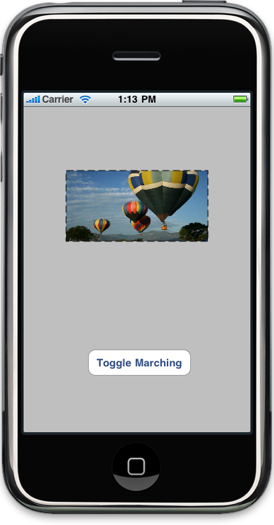 Our Core Animation book should be available by the end of the year. Go ahead and pre-order it now at Amazon if you would like ;-). When we started writing for Addison-Wesley back in September of 2008, I had no idea how long to expect it to take to finish a technical book as this was my first. One thing I discovered though, is that it is when you are about ready to go to production you start to realize all of the things that you probably should have added to the book, but didn’t think of in time. This blog post will cover one such item as a way to make up for not thinking of it in time. I may include this in a second edition if there is one, but consider this one a freebie. (more…)
UITableViewCell Dynamic Height
At first glance setting a height dynamically for table view cells seems a little daunting and the first most obvious answers that come to mind are not necessarily correct. In this post I will show you how to set your table view cell heights dynamically based upon the text content without subclassing UITableViewCell. You can subclass it, however, doing so does not make the code much cleaner as setting the height is done in your delegate for the table view itself rather than the cell anyhow. Read on to see what you need to know to make dynamic cell height sizing a breeze.
(more…)
UITabBarController with UINavigationController Using Interface Builder
I’ve seen a good bit of sample code that shows how to implement using a UINavigationController in a view controller that is managed by a UITabBarController, but I haven’t seen much on how to do it with Interface Builder. Turns out that it’s pretty simple and I’m going to show you how.
(more…)
Magical iPhone View Controllers
Update: This is documented behavior.
Every now and again while doing development you stumble upon something that makes you go, hmmmm. Those are normally the moments at which you have to ask yourself, “is this a bug or a feature”. If it’s a bug, then you should file a radar with Apple, however, what if it’s a feature? You blog about it, of course!
I have done a bit less iPhone development than Marcus, so he was a little stumped while looking through some of my code where I created a view controller using a simple alloc/init. Most interestingly is that fact that the app works. It loads the correct nib and displays the view just fine without any trouble. Notice I said alloc/init and not alloc/initWithNibName. How can this possibly work? How did my controller “know” which view to use?
(more…)
Record Your Core Animation Animation
Every once in a while I find a way to combine multiple technologies that, while they don’t produce anything terribly useful, are very interesting when combined. In this post I will be taking a look at combining Core Animation and QuickTime. As you may or may not be aware, you can draw in a graphics context while your Core Animation animation is running and add each image created to a QTMovie object from QTKit. This enables you to create a QuickTime movie of your Core Animation animation. Here’s how.
(more…)

Dropping NSLog in release builds
NSLog() is a great tool that helps debugging efforts. Unfortunately it is expensive, especially on the iPhone, and depending on how it’s used or what you’re logging, it could leak sensitive or proprietary information. If you look around the web, you’ll find a few different ways to drop NSLog in your release builds. Here is what I’ve put together based on those.
(more…)
Adding iTunes-style search to your Core Data application
iTunes has a very neat way of searching your library, where it takes each word in your search and tries to find that word in multiple fields. For example, you can search for “yesterday beatles” and it will match “yesterday” in the Name field and “beatles” in the Artist field. The basic predicate binding for NSSearchField provided by Interface Builder is not complex enough to archive this kind of search. I need to build the predicate dynamically since I can’t assume what field the user is trying to search and that each additional word should filter the list further – just like iTunes. Here is how to go about adding iTunes-style searching.
(more…)
Landscape Tab Bar Application for the iPhone
As you develop applications for the iPhone, you will likely use the project templates provided in Xcode. One such template, called “Tab Bar Application” helps you get a tab bar application set up quickly, but by default the application it generates only supports portrait mode for display. So how can you make the application also support landscape or even only support landscape? In this post we will address that question.
(more…)
Core Animation Tutorial: Interrupting Animation Progress
Starting and stopping animations in Core Animation is as simple as adding and removing your animation from the layer upon which is being run. In this post I am going to talk about how to interrupt animation progress and how to determine whether an animation completed its full run or was interrupted. This is accomplished with the animation delegate -animationDidStop:finished.
(more…)
Core Animation Tutorial: Slider Based Layer Rotation
It is often helpful to create a custom control for you application that will display a value as a level like a gas gauge shows how full your tank is. In this post I will demonstrate how to create a three layer tree that will show the current rotation of a circular layer as the value from a slider (NSSlider) is updated in real time. The layers include the root layer, the rotation layer, and a text layer that will display the current rotation in degrees.
(more…)
Cocoa Touch Tutorial: iPhone Application Example
Similar to one of my first blog posts on building a basic application for Mac OS X using xcode 3.0, I am going to explain for beginning iPhone/iPod Touch developers how to build the most basic Cocoa Touch application using Interface Builder and an application delegate in xcode 3.1. This tutorial post is really to provide a quick how-to. I won’t go into any depth explaining why things are done the way they are done, but this should help you get up and running with your first application pretty quickly so that you too can clog the App Store with useless superfluous apps (kidding… just kidding).
If you are a visual learner, it may be helpful to you to instead watch a video presentation of this tutorial. I’ve posted it on the site, but you’ll have to click the link to see my Cocoa Touch Video Tutorial.
(more…)